Community
A horror story - darkly funny, gut-punch brutal, about how ordinary people become instruments of authoritarianism, one cheerful phone notification at a time.

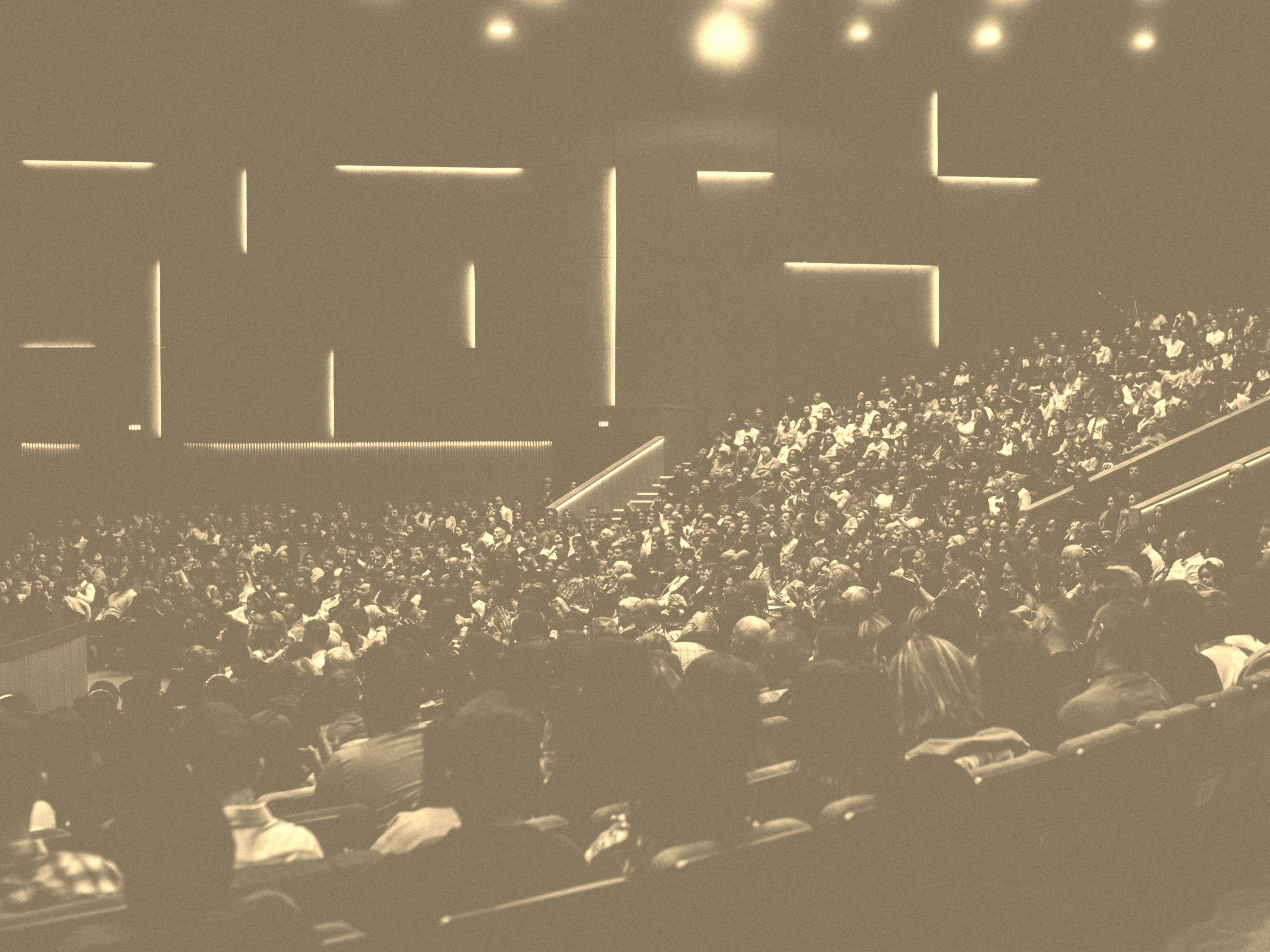
A Community Compliance Seminar
Wheeling, West Virginia, January 2026
The Elks Lodge on Sixteenth Street went up in 1952 and got renovated exactly never. Wood paneling covers every wall. The carpet, the particular orange-brown that only existed in the 1970s, hides cigarette burns and despair in equal measure. Above the small stage hangs a portrait of the president, smiling, next to an older portrait of an elk.
They pack nearly three hundred of us into folding chairs arranged in rows so tight your knees touch the back of the person in front of you. Farmers in overalls sit next to women in church clothes sit next to teenagers who’d rather be anywhere else. This is the fifth session of the day, trying to get everyone in the county in one day, more or less, minus the people who can’t get off work and will have to attend the Saturday makeup session, minus the people already in processing, minus the people who fled to Michigan or Canada or wherever people flee to these days when they see which way the wind blows.
The PowerPoint slide says Compliance is Key in letters the color of a ripe bruise, and beneath that, a cartoon eagle giving a thumbs-up with a wing it does not possess.
“Now I know what y’all are thinkin,” says the man from the Bureau of Compliance. He introduced himself as Bruce. “You’re thinking, Bruce, I got better things to do than sit in the Elks Lodge learning about how to be a Civic Compliance Partner.”
Nobody thinks this. Most of us are thinking about the cold cuts, sweating beneath plastic wrap on a folding table by the emergency exit. My cousin Jeb sits thinking about his boat payment. I know this because he said, “I can’t make my boat payment this month, gotta think about how to find more money,” when I sat down next to him.
“But here’s the thing,” Bruce continues. “Being a CCP isn’t just your civic duty. It’s…” He clicks to the next slide. A photograph of a white family eating dinner appears. They laugh at salad. “...it’s an opportunity.”
An elderly woman in the third row raises her hand.
“Ma’am, we’ll have time for questions at the–”
“I got the diabeetus,” she says. “How long’s this run?”
Bruce’s smile does not waver. I’ve seen that smile on preachers and one time on a man trying to sell me a Honda Civic with a cracked axle.
“About two hours, ma’am. But we’ve got refreshments.”
The woman considers the cold cuts. “I’ll manage,” she says.
The seminar, mandatory for all residents of Ohio County, comes after what Bruce calls The Wheeling Community Safety Success and what everyone else in town calls the time Compliance Officers pepper-sprayed a baby shower because someone reported hearing Spanish, which turned out to be the García-Williamses, who’ve lived here since 1987, listening to the new Bad Bunny at reasonable volume.
Fourteen people detained. Eleven citizens. One nun. The baby, the one they threw the shower for, came two weeks later and got named Resistance, which everyone agrees puts a lot on a child, but the mother, Jennifer García-Williams, who spent forty-six hours in a processing facility in Pennsylvania with no phone call and one meal of cold hot dogs, feels some type of way about it.
The remaining three detainees are still in processing, including Jennifer’s uncle Marco, who came to the country in ‘72, served in Vietnam, and recently celebrated his fifty-year anniversary of owning a dry-cleaning business downtown. His status remains under review, which Bruce explains means being reviewed.
“Due process,” Bruce says, “is a process. With dues. That are due.”
Jeb leans over. “Did he just say that?”
“He did.”
“That don’t make no goddamn sense.”
“It does not.”
Jeb writes something in his notebook. He brought the notebook because Lisa at the front desk told him there would be a quiz even though we all know there ain’t no quiz. Lisa’s been messing with all of us since ‘90, when she told the entire junior class Principal Meyers died and then, when everyone showed up to school in black, revealed she meant his cat.
“Now,” Bruce says, clicking to a slide with a helpful flowchart, “let’s talk about what constitutes Suspicious Activity.”
Arrows shoot in every direction across the flowchart, contradicting each other at every turn. At the center sits a diamond-shaped box, Does The Individual Appear Nervous?
“Nervousness,” Bruce explains, “is a key indicator.”
“Of what?” says Darnell Turner from the back row. Darnell once fixed my lawnmower for free because he said it insulted lawnmowers everywhere and he couldn’t let it stand.
“Of potential non-compliance.”
“Non-compliance with what?”
“With general expectations of behavior consistent with documented presence in the United States.”
“Man, I’m nervous right now,” Darnell says. “This place is hot as hell’s bells, I’m missin’ the Mountaineers game, and you keep showin’ us pictures of white people eatin’ salad. That make me a suspect?”
Light laughter ripples through the Lodge. Bruce waits for it to subside.
“Great question, Darnell. And this is where the app comes in.”
He clicks to the next slide. CivicShield. A shield with an eye stares out from the logo, which several people later agree strikes them as a choice.
“CivicShield allows you to report Suspicious Activity directly to the Bureau with one tap. You can include photos, video, GPS coordinates, and a brief description of why you feel concerned.”
“And then what happens?” Darnell asks.
“Trained agents review your report and take appropriate action.”
“What’s appropriate action?”
“Action appropriate to the situation.”
“Bruce,” Darnell says, “you are sayin words, but they ain’t connectin’ to each other in a way that means anythin’.”
Bruce’s smile holds. “I understand your frustration. Change is hard. But let me ask you this. Would you rather find out your neighbor’s a threat before or after something happens?”
“Depends on what’s happenin’.”
“Exactly.” Bruce points at Darnell as if he’s made Bruce’s point for him. “Exactly.”
He clicks to the next slide. The words Citizen Portal fill the screen above an image of a phone displaying a dashboard with numbers, graphs, and a large three-digit score in the center.
“Now, when you download CivicShield and become a Civic Compliance Partner, you automatically get enrolled in the Citizen Portal. Think of it like a credit score, but for your life.” He chuckles at his own joke. Nobody else does. “The Portal tracks your compliance score based on a variety of factors. Your associations. Your location history. Your purchasing patterns. Your employment status. Public statements you’ve made, online or otherwise.”
He clicks again. A new slide, Why Your Score Matters.
“Now, I know what some of you are thinking. Bruce, why do I care about some number on a screen?” He holds up a finger. “Here’s why. Your compliance score determines your access to essential services. WorkFirst Distribution Centers? You need a score above 650 to qualify for full rations. Sponsored Care facilities? Minimum 700 for non-emergency medical services, 750 for specialist referrals.” He pauses, letting that sink in. “Scores above 800 get expedited processing. Priority access. Shorter wait times. Better service.”
The room gets quiet.
“And here’s the beautiful part,” Bruce continues. “Every verified report you file as a CCP improves your score. You’re not just protecting your community. You’re protecting yourself. Your family. Your access to the things you need to live a productive life.”
He smiles. “Any questions so far?”
Nobody raises a hand. Nobody moves.
“Good. Let’s continue.”
The cold cuts enter a new phase of decomposition by the time we reach Module 3, Identifying Non-Standard Family Units. The slide shows several configurations of stick figures. Some bear check marks. Some bear question marks. None show both parents being the same gender, which Jeb’s daughter Mackenzie points out, because Mackenzie, home from Oberlin for winter break, itches for a fight since the moment Bruce said compliance.
“Excuse me,” Mackenzie says. “What does ‘non-standard’ mean in this context?”
“It means configurations requiring additional verification of documentation.”
“So like, my aunt Linda and her wife?”
“I can’t speak to specific situations.”
“They’ve been together thirty years. They run the bakery on Fourteenth.”
“The one with the cinnamon rolls?” someone asks.
“That’s the one.”
A murmur of appreciation goes through the room.
“Look,” Bruce says, “nobody’s saying your aunt is a target. We’re just saying certain family configurations may require–”
“What configurations?”
“–verification that all members are documented and–”
“They’re both from Moundsville, Bruce. Linda’s people been here since the coal camps. So have Sharon’s.”
“Again, I can’t speak to specifics. But if your aunt and her partner have nothing to hide, they have nothing to worry about.”
Mackenzie laughs, one sharp note, like a dog bark.
“Yeah,” she says. “That’s real comfortin’.”
During the break, I stand outside with Jeb and Darnell, passing around a flask Darnell brought because he said he had a feeling.
“This is some bullshit,” Jeb says.
“Certified,” Darnell agrees.
“They want us to spy on each other.”
“They want us scared,” Darnell says. “Scared people do what they’re told.”
A truck rolls past on Route 2. The back holds men in camo, nothing unusual, hunting season, after all, and half the county wears camo from October through February. But the truck ain’t heading toward the woods.
“My granddaddy worked the mines with Black folks and Polish folks and Italian folks and folks whose names he couldn’t pronounce,” Darnell says. “They all died the same way when the shaft collapsed. Didn’t nobody check papers first.”
“Darnell.”
“I’m just sayin. They got us aimed at each other so we don’t look up.”
Jeb takes a long pull from the flask. “Look up at what?”
Darnell gestures vaguely at the sky, at the Lodge, at the truck disappearing down the hill.
“At whatever idiots are runnin’ this particular circus.”
Back inside, Bruce cues up Module 4. Youth Compliance and School-Based Reporting. The slide shows a teenager on a phone. The caption, See Something, Say Something. Start Young.
Mackenzie pulls her phone out and begins recording.
“Ma’am, I’m going to need you to put that away.”
“Why?”
“This is a closed seminar.”
“It’s mandatory. For the public. That’s the opposite of closed.”
“Ma’am–”
“I’m not your ma’am, Bruce. I’m twenty years old. And I want a record of what you’re telling us to do to our neighbors.”
Bruce considers her. She considers him. The room holds its breath.
“Fine,” Bruce says. “Document away. We’ve got nothing to hide. Now, I want to talk about incentives.” He clicks to the next slide. A photograph of a smiling woman holding a check appears. The check blurs but the zeros stand out clear. “The CivicShield Reward Program offers compensation for verified reports leading to successful enforcement actions. We’re talking real money, folks. Someone exposed a Non-Standard Family Unit in Parkersburg last month, the reporting CCP received twelve hundred dollars. And a gentleman in Morgantown identified a Compliance Caution, Category Two, living right next door for six years. He got three thousand dollars.”
The room shifts, the way you feel the weather changing, a pressure drop.
“Three thousand?” says a man near the front. Barney Pruitt. He sells insurance out of a strip mall off the highway.
“Three thousand,” Bruce confirms. “And that’s just the baseline. Certain categories pay more. Gender Deviants, for instance, are some of the highest payouts. Document Fraud. Harboring.” He lets that last word sit there. “Harboring pays very well.”
“How well?” Barney asks.
“Five thousand. Sometimes more, depending on quantity.”
Barney Pruitt takes out his phone.
“Got a question,” Barney says, not looking up from his phone. “If I report someone and it turns out they’re clean, do I get in trouble?”
“Absolutely not. We encourage reporting even if you’re not certain. Let the professionals sort it out. That’s what they’re trained for. Better safe than sorry, right?”
“Right.” Barney types something. His thumb hovers over the screen. “And it’s anonymous?”
“Completely anonymous. The reported party will never know who filed.”
Barney presses submit.
His phone chirps, small and cheerful, like a video game reward, like he’s just matched three candies in a row.
Bruce’s own phone buzzes in his pocket. “Well, folks, looks like we’ve got our first CCP of the evening!”
He reaches into his jacket and produces a crisp new hundred dollar bill. He walks down the center aisle and hands it to Barney Pruitt, who takes it like a man accepting communion, with reverence.
“A hundred-dollar CCP Bonus,” Bruce announces. “Just for filing your first report. The first of many, I hope. And don’t forget, that report just bumped your compliance score. You’re already on your way to priority access.”
Barney holds the bill up so the people around him can see. A hundred dollars. For typing a name into a phone. And a higher number on a screen that determines whether you eat this month.
“Now,” Bruce says, walking back to the front of the room. “I want everyone to take out their phones.”
The room stirs. People reach into pockets, purses, jacket linings.
“This seminar, as you know, is mandatory. So is this next part.” Bruce clicks to a new slide. A QR code fills the screen. “I need everyone to scan this code and download CivicShield. This is a federal requirement as of January first. Every citizen in Ohio County must be registered as a Civic Compliance Partner by the end of the month. Think of tonight as a head start.”
Three hundred phones rise into the air, screens glowing, cameras pointing at the QR code, a bunch of flowers turning toward the sun.
“Once you’ve downloaded the app, you’ll be prompted to create your Citizen Portal account. Follow the instructions. Accept the terms of service. And when you’re done, I want to see three hundred confirmation screens. I’ll wait.”
The room fills with the soft sound of fingers on glass. Tapping. Scrolling. The little chirps of successful downloads, the pings of Portal activations, one after another after another.
I stare at my phone then glance back at Darnell, two rows back, his phone still in his pocket, his arms crossed over his chest.
“Is there a problem, sir?” Bruce’s words, still pleasant, cut through the noise.
Darnell doesn’t move. “I ain’t puttin’ that thing on my phone.”
“Sir, this is a federal requirement. Non-compliance carries penalties.”
“Then penalize me.”
Bruce’s smile doesn’t waver. “Sir, I’m going to give you one more chance to–”
“I said no.” Darnell stands up. “I ain’t spyin’ on my neighbors. I ain’t sellin’ out people I known my whole life for a hundred dollars and some made-up number that says whether I’m allowed to see a doctor!”
The room goes quiet. Every phone stops moving. Every eye turns to Darnell.
Bruce shifts his focus to me.
“And you, sir? I notice your phone’s still dark.”
“I’m thinkin’ about it,” I say.
“Think faster.” Bruce checks his watch. “You’ve got thirty seconds.”
I look at the QR code. Look at Darnell, still standing, arms still crossed.
Twenty seconds.
I think about the compliance score. About what happens when your number drops below 650 and the grocery store won’t let you in.
Ten seconds.
I think about my mother, who came to this country in ‘62 and worked three jobs to put me through school and died in 2019 believing America meant something.
Five seconds.
I put my phone back in my pocket.
Bruce nods. “Alright then.” He turns to the room. “This is an excellent opportunity for our new CCPs. We have two individuals here who have refused to comply with a federal mandate. I want everyone to open their apps. Go to the report function. And file.”
The chirping starts within seconds. Dozens of phones. Small cheerful sounds fill the room, a chorus of tiny digital bells, and Bruce walks up and down the aisle handing out hundred-dollar bills, and the people who take them smile like this is a game they’re finally winning.
“Yinz know what you’re doin?” Darnell says. “Yinz understand what this is?”
Nobody looks at him.
“This is your neighbors,” Darnell says. “This is people you known your whole lives. This is–”
“Sir,” Bruce says, “I’m going to need you to take your seat.”
“I ain’t sittin’ down.” Darnell steps into the aisle. “I ain’t sittin’ down while yinz sell each other out for a hundred goddamn dollars and some points on a screen. Tommy.” He points at a man three rows up. “Tommy, I coached your boy in little league. Taught him how to throw a curveball. You just put my name in that phone, didn’t you? After everything I done for your family?”
Tommy won’t look at him.
“Sir.” Bruce’s hand moves to his belt, to the small black device clipped there. “Final warning. Take your seat.”
“Brenda.” Darnell turns to a woman by the window. “Brenda, I fixed your roof after the storm in ‘19. Didn’t charge you nothin’ because your husband just passed and I knew you hurt. You remember that? You remember what neighbors used to mean?”
Brenda cries. She also holds her phone close to her chest and then it chirps from a report filed. Darnell grabs the phone out of her hand and throws it against the wall. It shatters.
The room goes silent.
Bruce presses a button on his belt.
The doors at the back of the Lodge burst open. Four officers come through, moving fast, batons already drawn. Darnell sees them coming and does something I’ve never seen him do in all the years I known him. He puts up his fists.
“Come on then,” he says. “Come on.”
The first officer reaches him and Darnell swings, catches him clean across the jaw, sends him stumbling into a row of folding chairs. The second officer comes in low and Darnell knees him in the chest, and for a moment I think he might actually make it to the door, might actually get out, might actually–
The third officer hits him with the black prod.
Darnell’s whole body seizes, his back arches, his eyes go wide and white. He falls hard, his head bounces off the floor, and the officer shocks him again, and again.
“Domestic terrorism,” Bruce announces. “Assault on federal officers. Destruction of government-mandated equipment. Incitement to non-compliance.” He reads from his phone, checking boxes on a form. “Category One offense. Permanent detention. No trial, no appeal, no visitation.” He looks up at the room, at all the faces frozen. “Let this be a lesson, folks. This happens when you don’t cooperate. This happens when you think you’re above the law.”
They zip-tie Darnell’s hands behind his back. They zip-tie his ankles. One officer puts a knee on his neck while another fits a black hood over his head. They drag him out by his feet. His head leaves a thin red smear on the carpet.
Bruce steps over the smear like a crack in the sidewalk.
“Now,” he says, clicking to the next slide, “where were we?”
My phone buzzes in my pocket. I never downloaded the app. Never scanned the code. But there it sits on my screen anyway, pushed through.
The notification says You’ve Been Reported. (147 Reports Filed)
It says Remain Calm.
It says Compliance Officers Will Arrive Shortly.
Below that, a second notification comes through. Citizen Portal Activated. Your Compliance Score, 12. Non-Compliant.
Mackenzie still films. The only phone in the room not running the app. Bruce notices. “Ma’am,” he says. “I’m going to need to see that phone.”
Jeb stands up. “Now hold on–”
“Sir, sit down. Unless you want to end up like your friend.”
Jeb looks at the smear on the floor. He sits.
They take the phone from Mackenzie’s hand. They take Mackenzie too.
“Mackenzie Pruitt,” Bruce says, reading from his phone. “Reported for Unauthorized Recording of Government Proceedings. Reported by–”
He stops. Glances at Barney Pruitt, still holding his hundred-dollar bill.
“Well,” Bruce says. “Isn’t that something.”
They take Mackenzie out the door. They take others whose names I recognize, charged with things like Suspicious Behavior and Concerning Associations and Sexual Deviant, and in one case, Unverified National Origin, which means Maria Chen, whose family has run the Chinese restaurant on Market Street for forty years, whose grandfather built the place with his own hands after the war.
When they call my name, I stand.
The officer zip-ties my wrists. The plastic bites into my skin.
As they walk me toward the door, I pass Jeb. Still sitting there, phone in his lap, flask on the floor where he dropped it. He stares at the floor.
“Jeb,” I say.
He doesn’t answer.
“Jeb. You report me?”
“I’m sorry, I’m sorry, I didn’t–they said it was mandatory, and you didn’t download it, and I didn’t think–I needed the score, I got that thing on my liver, and without Priority Status I can’t get in to see the specialist, and I–”
The officer pulls me forward. The door opens onto the parking lot, where black SUVs wait in the cold January night to whisk me away. The last thing I hear from inside, Bruce, calm and cheerful, thanking everyone for their participation.
“Remember, folks,” he says. “If you see something, say something. And don’t forget to check your Citizen Portal for updates on your compliance score. God Bless America and God Bless Our President.”
“God Bless America and God Bless Our President,” the room says back.
The door closes behind me.
Thanks for reading!
If you liked the world created in this story, you can continue with another stand-alone in the same world here:
Devastated the whole time. Why are we in Hell...thanks for sharing, this is an excellent lens. I hope it reaches those it needs to.
Frickin’ hell. That escalated fast. Well told story of human nature and how corrupt power manipulates ordinary people.